The Foundation's message
Nobody built them a bridge.
What the Luddites were actually afraid of, and why they were right.
Who wrote this. The Webspinner Foundation's position on generative AI — what it can and cannot do, why the noise around it is about something else, and the answer nobody gave the weavers of 1811.
There is a great deal of noise about artificial intelligence just now, and very little of it is about what the thing actually does. So let us start there. Honestly. With what it cannot do.
Computing has a rule older than anyone reading this. Garbage in, garbage out. A machine fed nonsense returns nonsense, politely, and at speed. Nothing about a language model repeals that rule. It sharpens it.
Here is a demonstration rather than an assertion. The model our course teaches you to build learns from a million characters of Shakespeare. Romeo appears on a hundred and sixty-three lines of it. Coriolanus, a hundred and fifty. And Hamlet — the most famous play in the English language — appears on exactly none.
So ask it about Hamlet anyway. It does not hesitate. It does not tell you it has never read the play. It writes two hundred confident characters of something that is not Hamlet, inventing speakers who never existed, because it has no way to know the difference. It does not know that it does not know.
That is the entire case for curated content, and it is not a small one. A model is a mirror of what it was shown. Choose the corpus badly and you have built a machine that is confidently wrong, at scale, forever.
## At its best, a slot machine
Now the other half of the honesty, which is the more interesting half. At its best — trained well, on good text — what is a model actually doing?
It is running a slot machine. Every character it writes, it spins a wheel with sixty-five positions on it. These are the real odds from the model we built: thirteen per cent on the letter s, eleven on p, nine on w. Then it pulls the handle.
The odds are better than Vegas. Untrained, every slot is one in sixty-five. Trained, its best guess is nine times likelier than chance, and Vegas never learns. But a weighted wheel is still a wheel.
And here is the number nobody quotes at you. After all that training, at every single character, it is still torn between about six. Six. Not one. That is the state of the art, only scaled up.
So inference is not calculation. It is an educated guess, drawn from the facts it happens to hold. A very good guess. Never a certainty. Anyone who tells you otherwise is selling you something.
## Then why the noise?
Not because of what it is. Because of what it will, in all probability — pun intended — become.
Artificial general intelligence: a machine that can learn, reason, and perform any intellectual task a person can. It does not exist. Serious people disagree about whether it ever will. And nearly all of them are building toward it.
Is that a problem? We think it is precisely the problem every great science has ever been. Fire. Print. Fission. The gene. Each one used for good. Each one harnessed for harm. Some will weaponise this one too, and that work is already funded. We would rather spend ourselves on the other side of that ledger, and that takes people.
Which brings us to the noise itself. Look at the polarity in our politics and you learn what the news business is now for. Not newspapers. Clicks. And the people who run it know something old and ugly: fear carries a reader further than principle does. So we are not going to sell you fear, uncertainty and doubt. There is a long queue for that. We would rather hand you the thing in genuinely short supply, which is hope, and something to do with it.
## 1811
One last thought, and it is two centuries old.
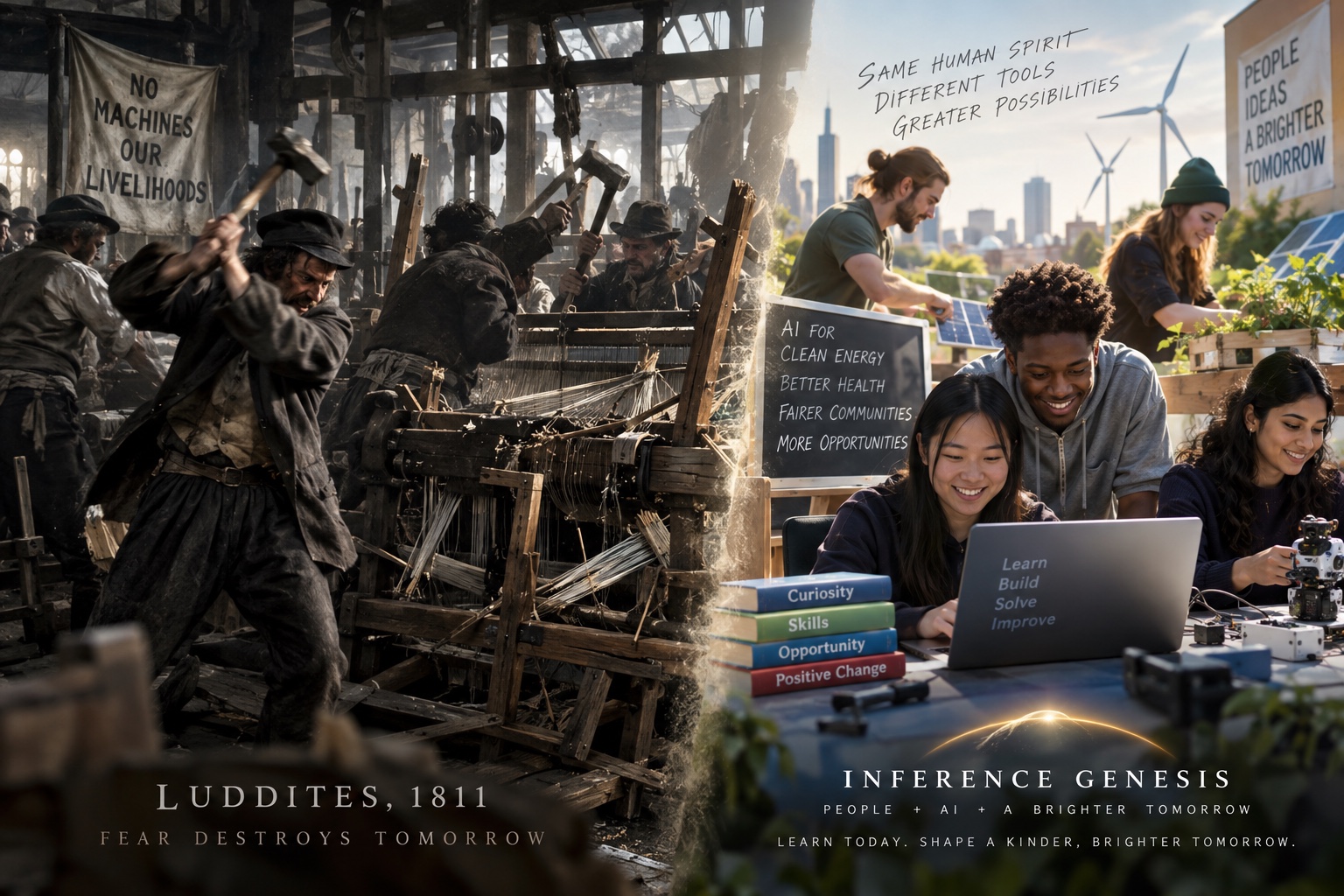
In 1811, in Nottingham, skilled textile workers watched machines arrive that were faster than they were, cheaper, and needed almost none of their skill. They banded together under a name that belonged to nobody — Ned Ludd — and they broke the frames. By 1812 breaking a machine was a hanging offence. In 1813 they hanged seventeen men at York for it. And the machines won anyway. They always do.
Read what the weavers actually wrote, though, and you find the thing that is almost never said about them. They did not hate machinery. They were terrified of ruin. Of wages through the floor. Of a trade that fed a family becoming a job that could not.
And they were right. Their craft did die. The cloth got cheaper, the country got richer, and the men who broke the frames were never made whole. That is the real failure of 1811. Not the looms. Nobody built them a bridge.
## We know how to build one now
This is not speculation either. It is ordinary economics, it has been done before, and it has three parts.
First, you carry people across. Retraining funded before the job goes, not after. And wage insurance that covers the gap while somebody learns the new work, so that learning it is not a punishment.
Second, you share what the machine makes. Automation throws off an enormous surplus. The eight-hour day and the five-day week were once exactly that surplus, handed back. Worker equity does the same thing with ownership instead of hours.
Third, you protect the person and not the job. Health cover and a pension that follow you rather than your employer. And a floor beneath everyone, so that a decade of fast change is survivable.
Those three take governments and employers, and we hope they step up. But you should not wait for them, and you do not have to. There is a fourth answer that needs nobody's permission: teach yourself. AGI is coming. We are not going to stop it, and on balance we would not want to. We can own it.
Do not smash the loom. Own one.
So stay the course. This need not be a thing you brace against — learning how it works can become one of the genuine delights of your life. And a model you built yourself is a thing nobody can take back.
We are the Webspinner Foundation. Stay with us.